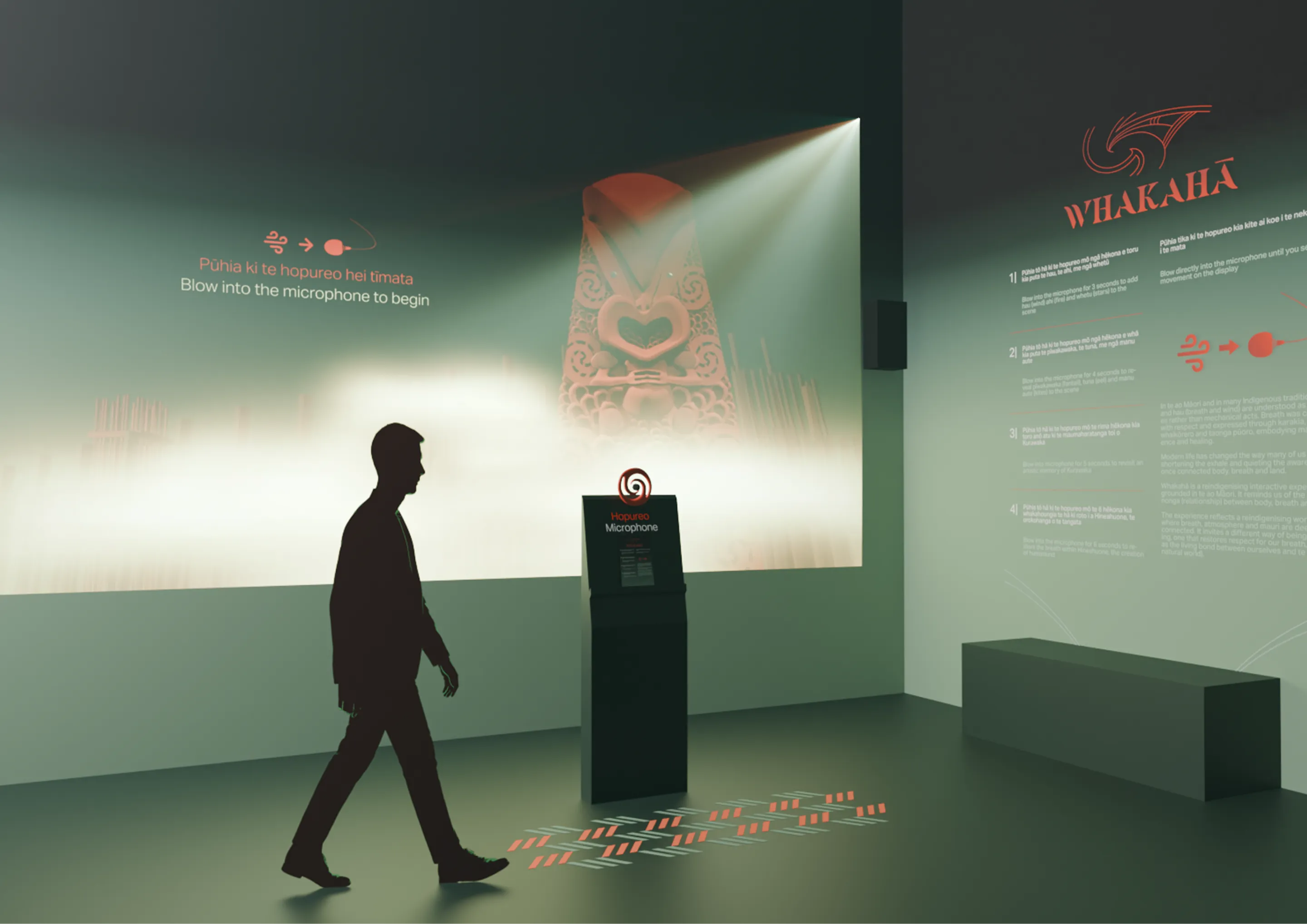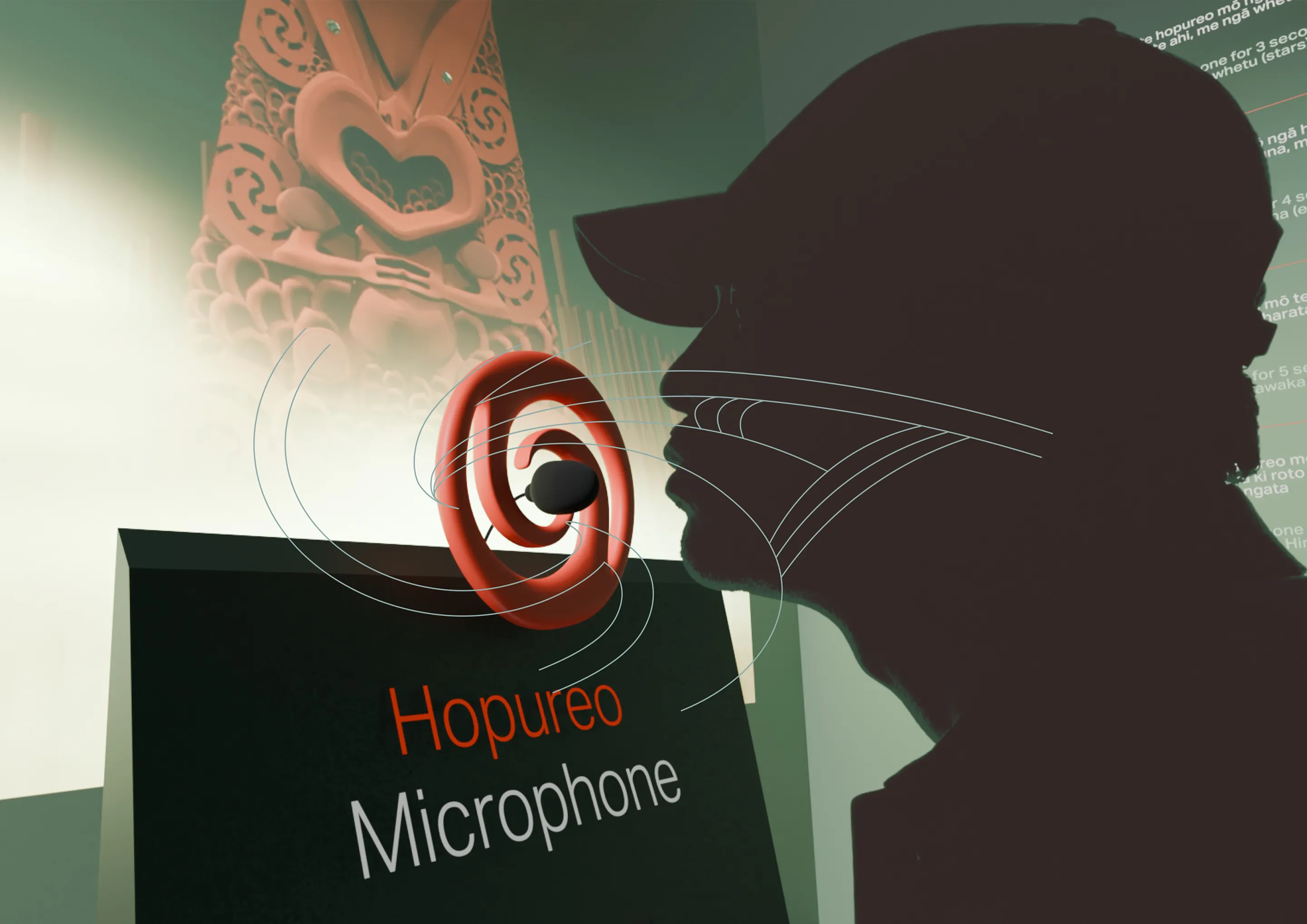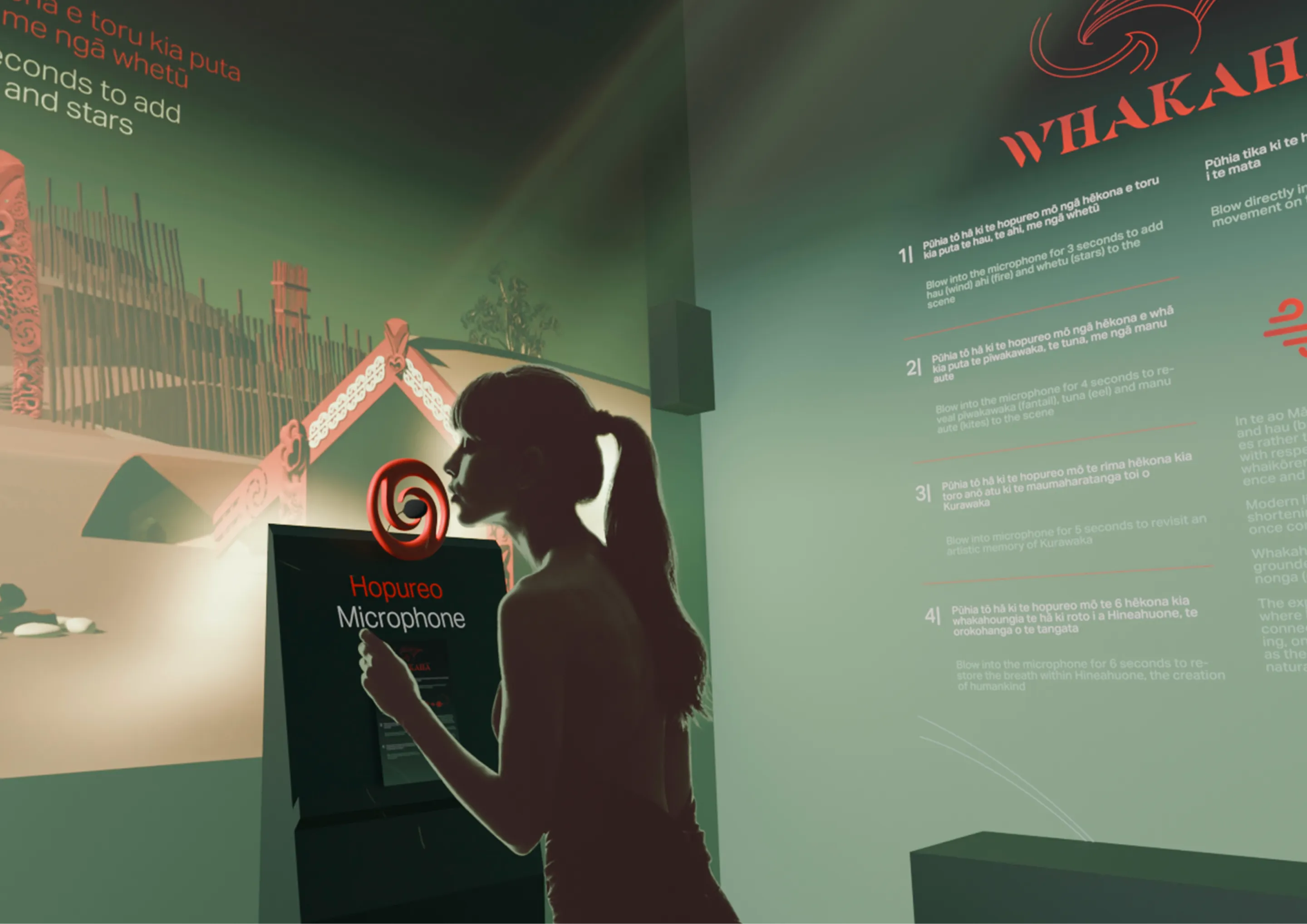
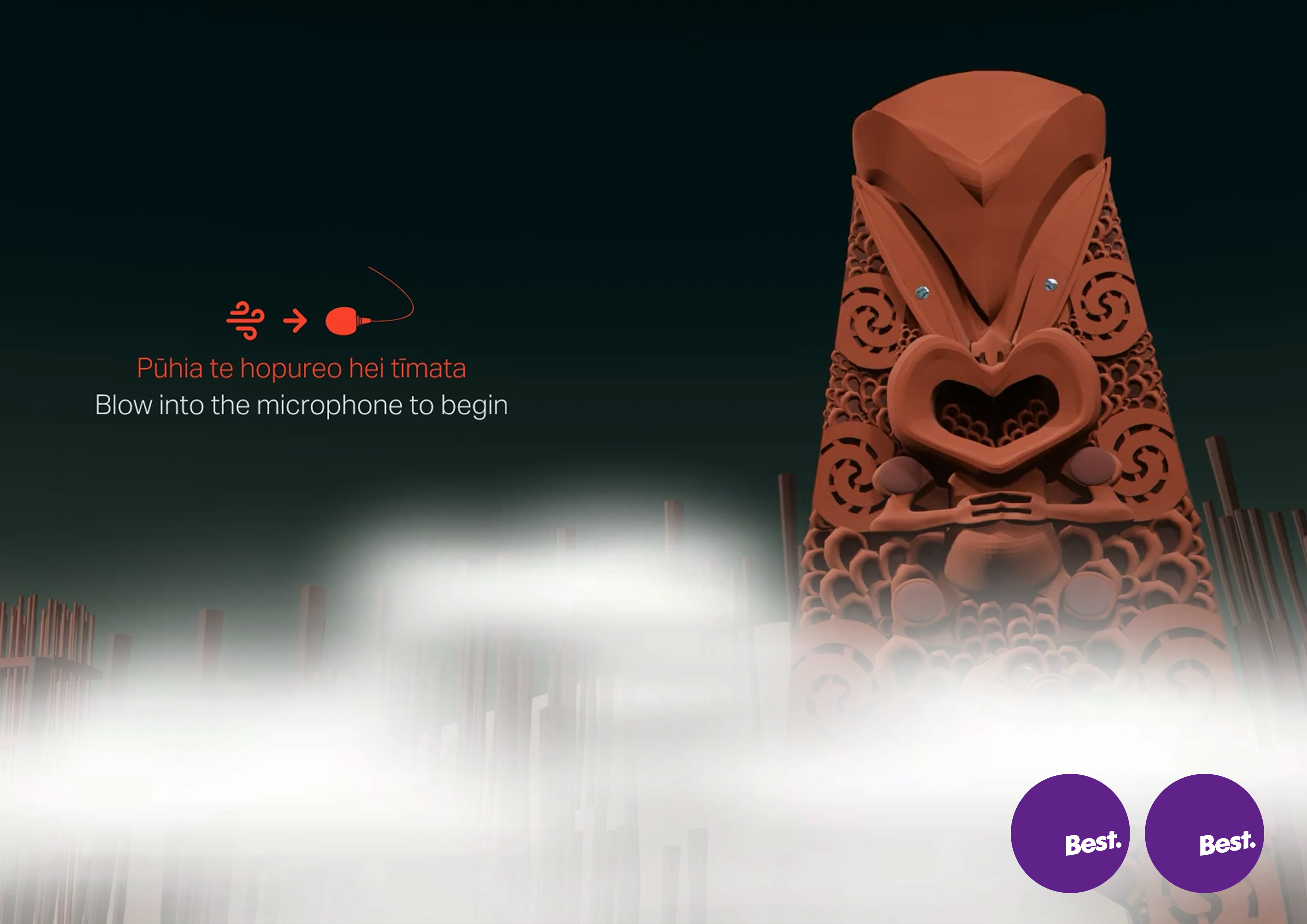
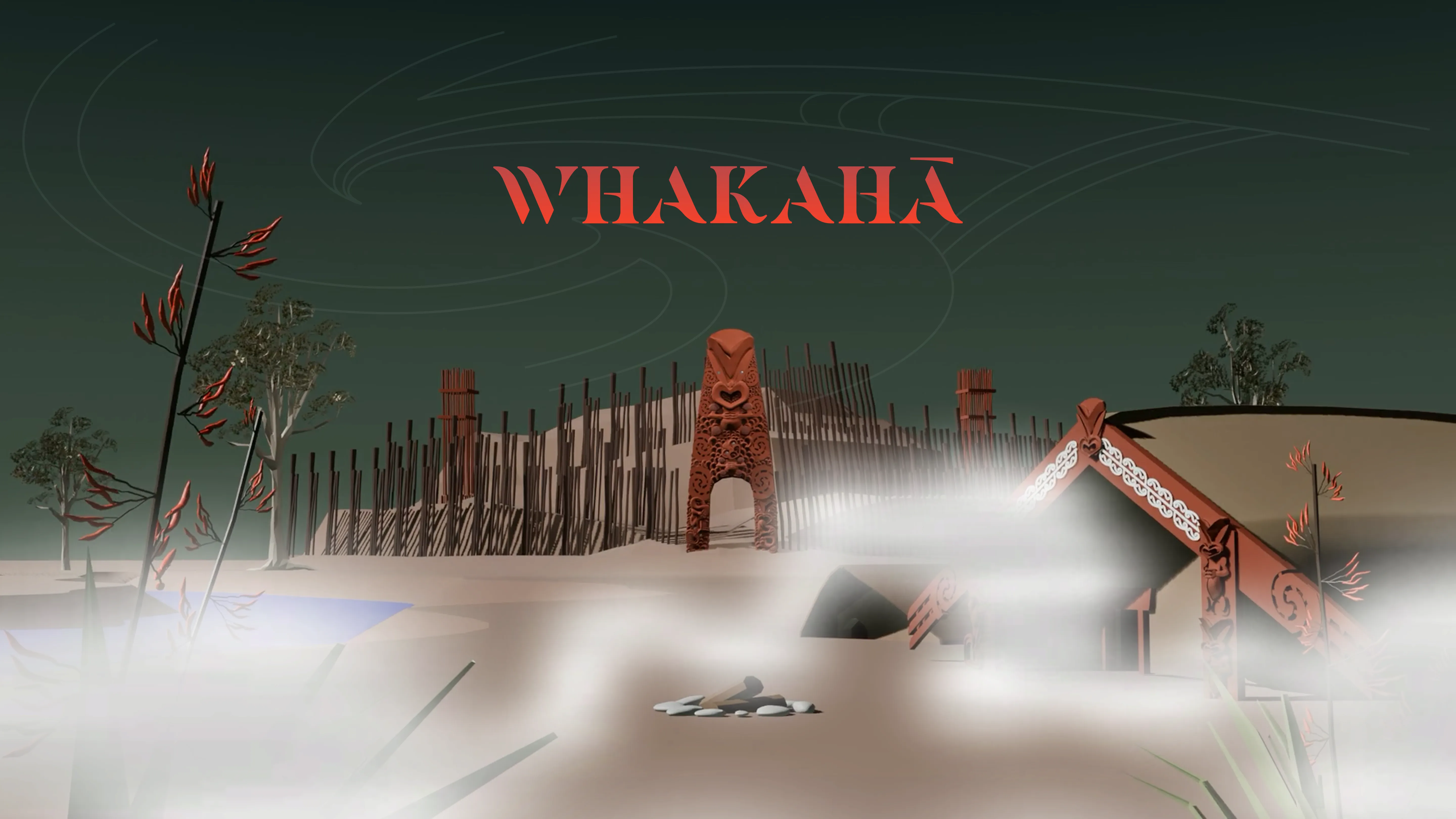
Whakahā is a breath triggered installation aimed to reconnect users with the way they respect their breath.
In te ao Māori, hā was viewed and respected differently; fundamental to creation stories, interconnected with our mauri, well-being and the natural world and embodied in every day life through karakia, whaikorero, pātere, puoro and much more.
This project challenges western design systems and uses modern technology to create a re-indigenising digital experience grounded in te ao Māori worldview. Whakahā is triggered by our hā, our breath input, using the microphone provided to activate sound, motion, and environmental storytelling that educates and guides the user towards learning the hononga, the relationships between our tinana, taiao, wairua, and pūrākau.
Whakahā is designed for people experiencing tension, stress and disconnection from their tinana or culture.
Outcome/Output
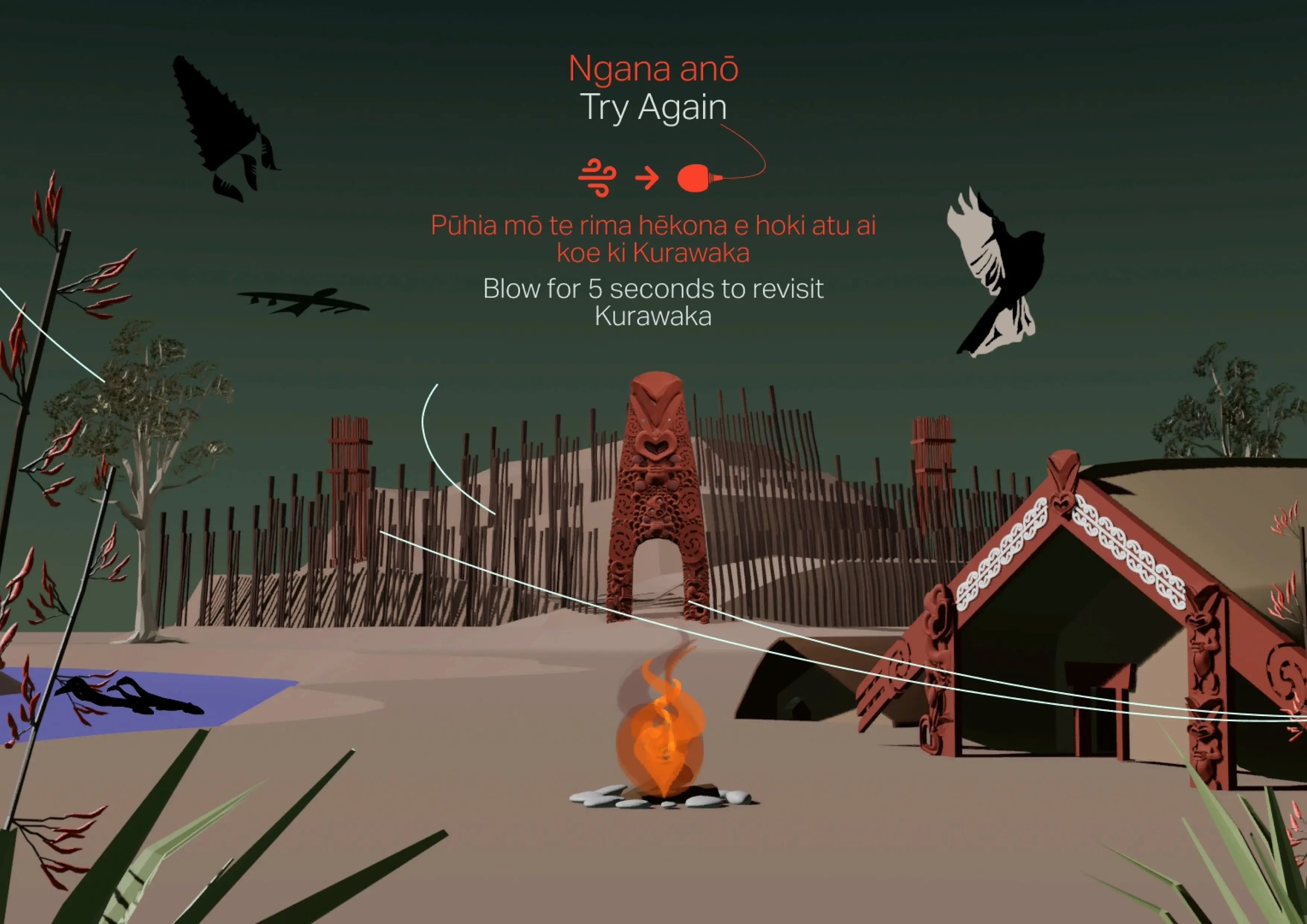
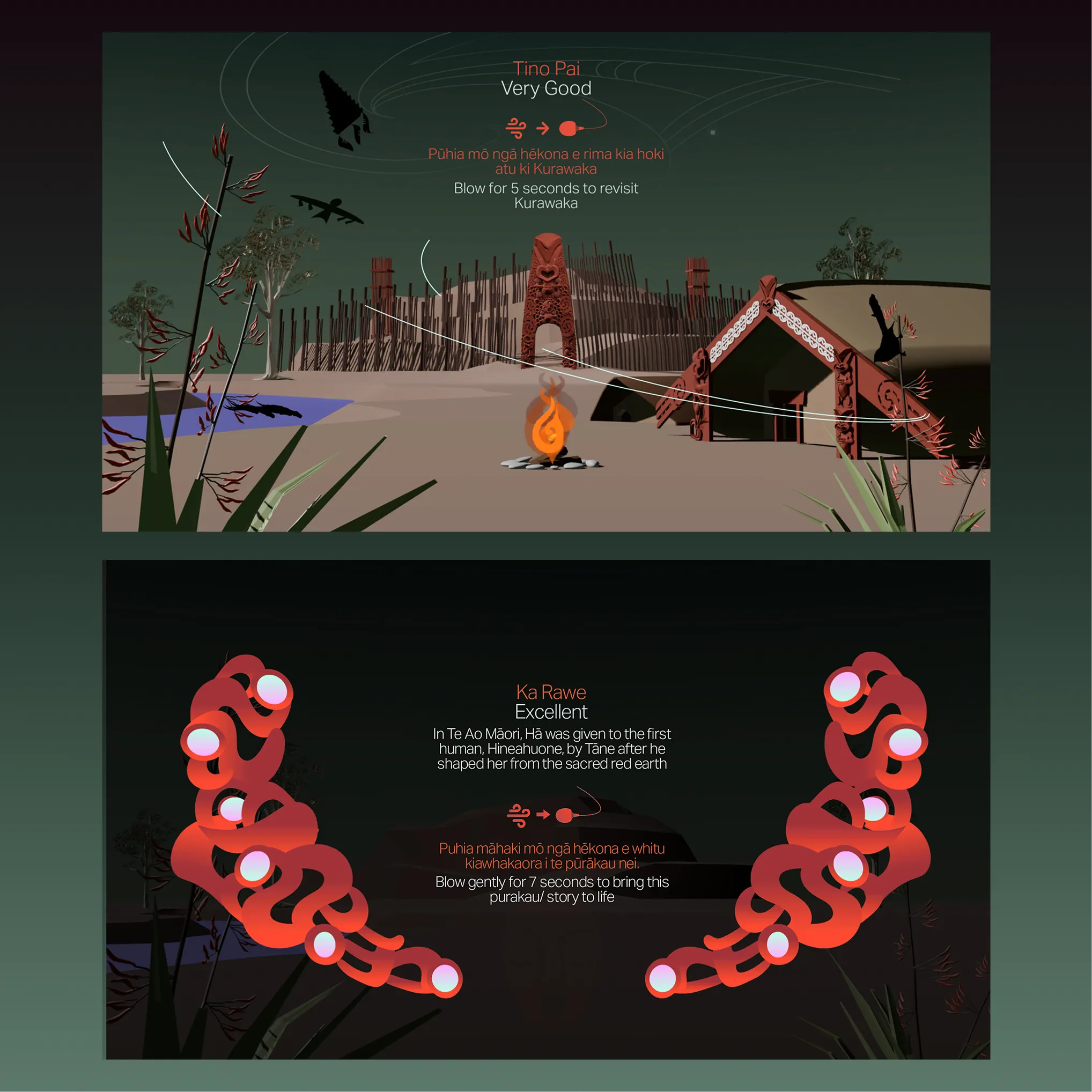
Real-time responsive environment where breath restores balance and activates visual states
Problem statement
Modern society has lost the celebration and respect once given to breath, creating a need for design approaches that help people reconnect with its cultural and life-giving significance.
Design question
How can digital interaction be used to revive Māori understandings of hā (breath) as a foundational connection between people, our tinana (body) and whakapapa?
Design approach
My design framework positions digital interaction as a bridge
between ancient understandings of hā (breath) and contem-
porary digital life. The aim is not to instruct users on how to
breathe, but to create an experience that reawakens respect
for breathing itself. Rather than treating breath as a mechanical
function, the interaction recognises it as a living connection
between people, body, and whakapapa. This reflects mātau-
ranga Māori, maramataka, and the value of observation and
relationship within te ao Māori.
Whakahā acknowledges that there is no single correct
way to breathe, only different levels of awareness and connec-
tion. Whakahā becomes both an act of reindigenisation and a
reminder that digital design can help us rediscover embodied
respect for our hā. Designed to reconnect users with the lost
respect for their breath, body, and ancestral rhythms of life,
Whakahā seeks to leave a lasting impression.
Rather than instructing users how to breathe “correctly”, Whakahā positions breath
as symbolic input. Technology does not judge or quantify breath, it responds to it.
Rejecting metrics, scores, and medicalised breath
Although research supports the benefits of slow, controlled breathing, translating breath
into scores, targets, or performance metrics was intentionally rejected.
Most breath-tracking technologies assume there is a single “correct” way to breathe.
This frames breath as something to be measured, corrected, and optimised. In Te Ao Māori,
breath is not mechanical. It is hā, carrying hau, mauri, and wairua, and it changes with
environment, emotion, and circumstance.
From an ethical perspective, breath data is deeply personal. Treating breath as data to be
captured, stored, or owned raises serious concerns around user intrusiveness and data
sovereignty, and echoes extractive relationships between bodies and technology.
Trade-off: This meant sacrificing numerical precision, performance feedback,
and the sense of optimisation common in wellness technologies.
Hononga, observation, and letting the land teach
Rather than instructing users how to breathe, Whakahā invites observation. Breath is not
evaluated. It is responded to.
The experience draws on Māori modes of learning grounded in hononga and maramataka,
where understanding emerges through relationship, rhythm, and attentiveness to the
environment. Users are not told when they are doing things “right”. Instead, they observe
how the world responds to their presence over time.
When balance is found, the environment settles and comes alive. When balance is lost,
the world gently quietens without judgement. The land remains the teacher, and the user
learns through noticing change rather than receiving instruction.
This approach preserves dignity, avoids medicalisation, and aligns with tikanga Māori,
where breath is honoured through relationship and balance rather than correction.
User testing
It took a while to complete motion assets and get the interaction working, so majority of testing was done late.
Early testing showed that responsiveness to breath was crucial. Zero lag felt significantly more realistic and impactful, whereas any delay reduced immersion. The original plan was for life to appear after a timer was met to encourage longer, more complete exhales.
The chronological order needed to be carefully considered. The timing of the scene coming to life had to make sense immediately, otherwise users became overwhelmed by instructions.
Breathing too big from the beginning would make users light headed, so starting short was a key insight to story-telling.
UI cards needed to be intentionally positioned. When centered vertically, they obstructed the scene and reduced anticipation.
Surrounding audio interference would sometimes trigger animations pre-maturely. The audio input was refined using a high-pass filter to isolate the frequency range generated by breath, improving detection accuracy and minimising interference from ambient noise. This was important if installation would be public.
These insights led to:
Immediate visual and audio feedback on exhale
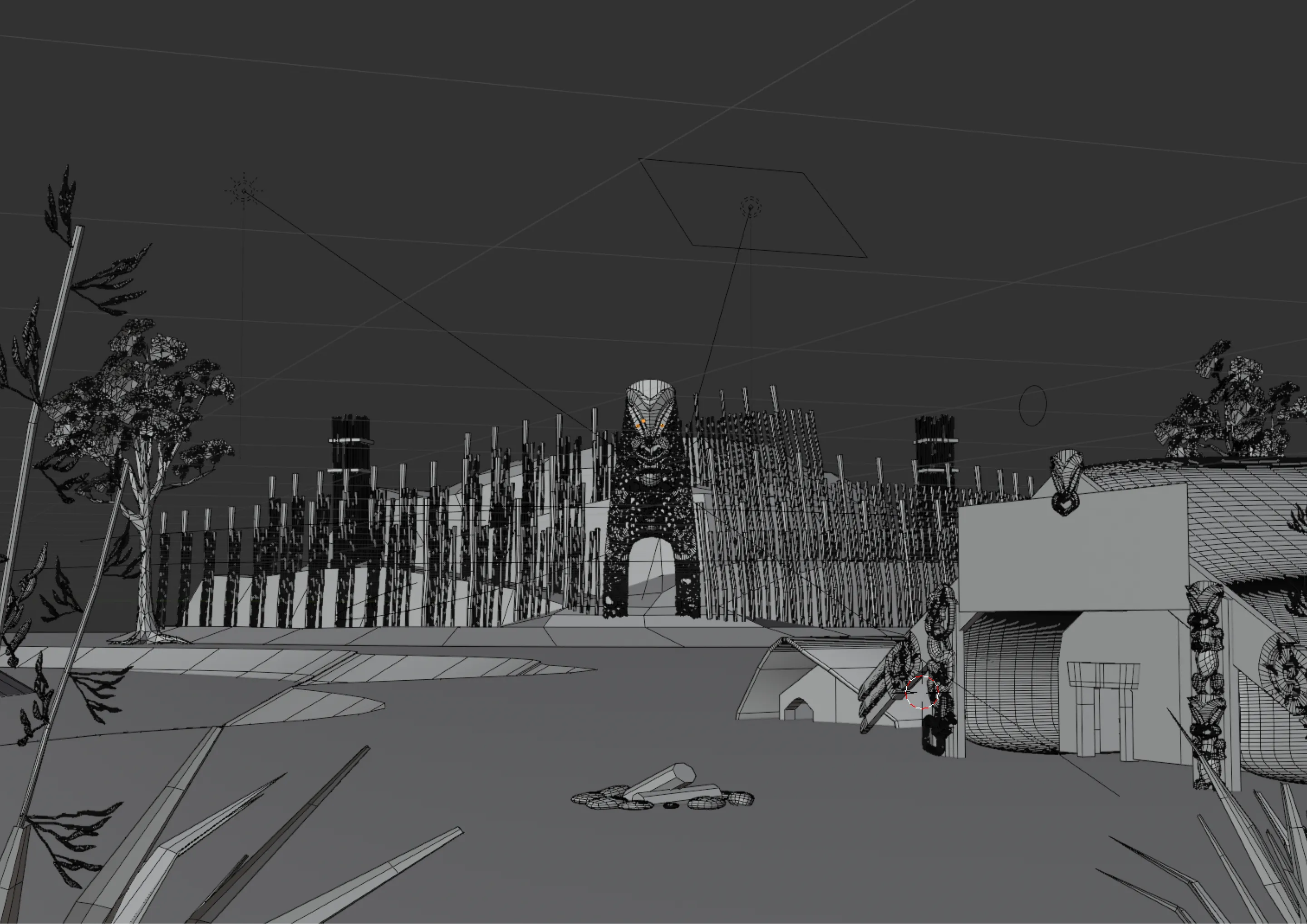
Thoughtful cultural and environmental story-telling
Shorter, safer breath thresholds
Clearer UI phase transitions
Improved scene visibility during UI transitions
Warmer lighting and increased atmospheric depth
Later testing confirmed the experience no longer felt like a game or wellness app, but a reflective,
embodied interaction focused on balance and mauri.
Brand Identity & Story
Visuals
The experience uses breath as a trigger for environmental transformation. Fog clears,
fire ignites, wind stirs, and life returns to the landscape. In this way, digital interaction becomes a medium for restoration, not correction. The whenua is still the teacher, and observation is still the tool.
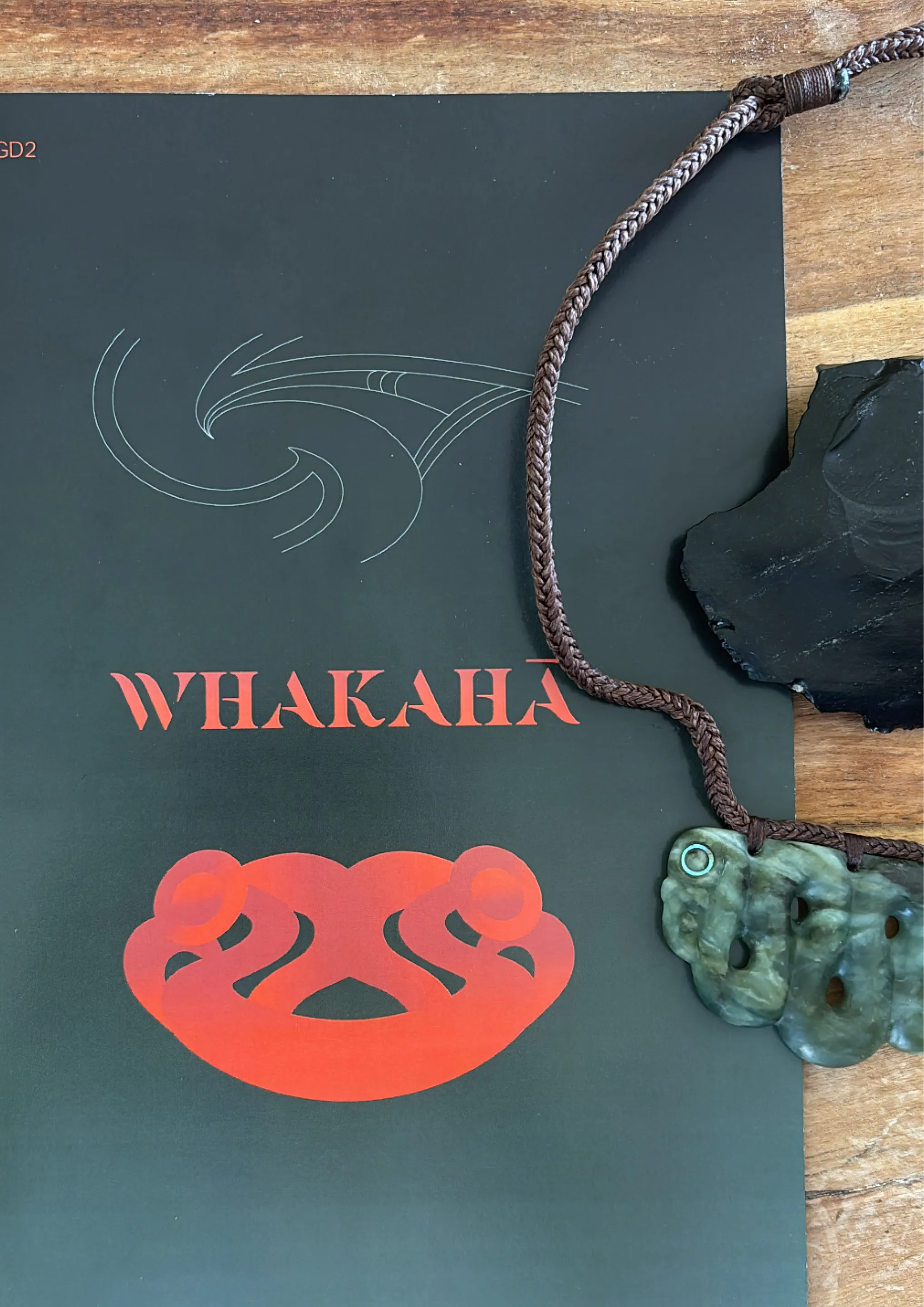
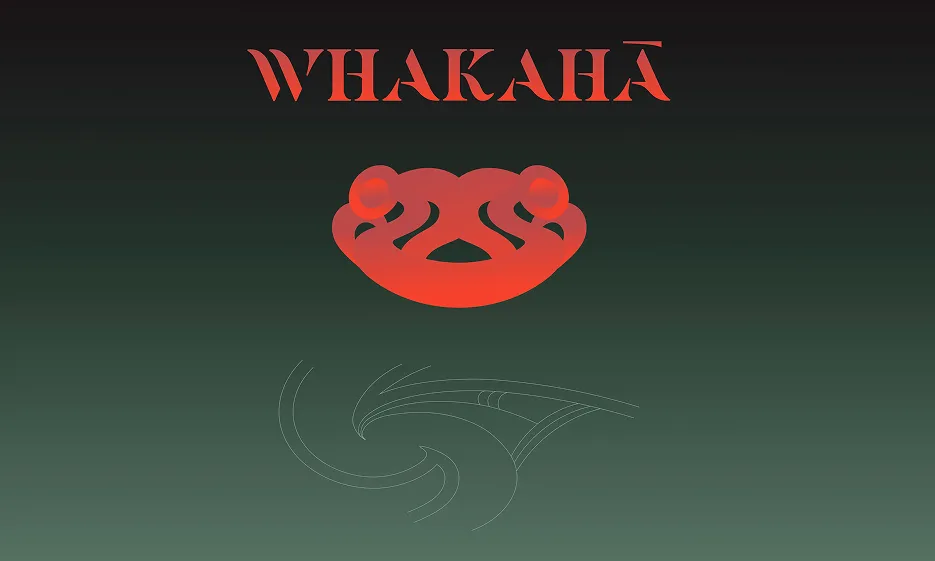
The branding shifted throughout the project, changing from a monochrome orange horizon theme to a dark green gradient. The initial orange and pink palette was intended to reference the skies of Aotearoa and reflect how Māori visual language has traditionally drawn inspiration from the natural world. However, as the project developed, the orange began to read as more outback or pan-Indigenous rather than distinctly Aotearoa-specific, unintentionally evoking Australian desert imagery rather than local whenua and atmosphere.
The shift toward darker greens and blacks better supported the emotional tone of the experience. It reflected the unsettling, serious nature of breath disconnection, while more accurately evoking the native landscape and night sky of pre-colonial Aotearoa. The green-black gradient is inspired by Mayor Island, Tūhua, a highly prized taonga for tangata whenua. Tūhua is unique among obsidian for its deep green tint when held to the light, and this quality became a visual reference for depth, vitality, and latent life within darkness.
Key UI design decisions
• Replaced metric dashboards with a relational tohu + hononga system, allowing users to understand ecological cause and effect rather than isolated data points
• Prioritised community-led knowledge over automated systems to ensure insights remain grounded in lived experience rather than passive data collection
• Introduced optional back-end AI to organise community data, improving clarity without compromising data sovereignty or increasing user effort
• Refined the tohu network into nodes and tags, creating a minimal structure that keeps relationships readable while maintaining ecological accuracy
• Introduced dual navigation (list + bubble network) to balance accessibility with deeper relational exploration, supporting both quick scanning and emotional engagement
Constraints and trade-offs
• A key trade-off was balancing ecological complexity with usability. While environmental systems are deeply interconnected, simplifying the interface was necessary to keep relationships readable and accessible. The key was to create access points that lead to deeper knowledge when needed and when users desired during testing.
• Translating concepts such as tohu and hononga into a digital interface required balancing cultural accuracy with usability, as these ideas do not directly map to conventional UI structures.
• Introducing AI offered efficiency in organising community knowledge, but raised concerns around environmental cost and data sovereignty, leading to an optional and localised approach.
• Balancing emotional, culturally expressive visuals with functional clarity required restraint, ensuring the interface remained usable while still conveying the unique nature of the knowledge system.
Reflection
This project strengthened my ability to design systems that guide interpretation rather than simply display information, especially when working with complex, culturally grounded knowledge.
One of the most challenging aspects was designing around te reo Māori concepts such as tohu
and hononga. These ideas do not translate directly into English, which made structuring navigation and UX
language more complex. For example, hononga holds meanings of both connection and relationship, while also
existing as its own concept. Designing with this in mind required more care, but ultimately led to a more
meaningful system.
Given more time, I would continue refining how hononga are visualised, exploring more Māori patterns, motiffs or icons, and trying spatial or 3D scans of the river for a high-tech dashboard. A key focus would be improving how relationships
between nodes are expressed, especially in the community or when community members interact and connect
nodes, ensuring the system remains minimal while still feeling emotionally engaging and cognitively clear.
I would also continue user testing to refine how people interpret and navigate these relationships, while
strengthening consistency across the UI through scale, spacing, and overall system cohesion. I would further
develop culturally grounded UI elements, and collaborate with fluent te reo speakers to strengthen the
language and interaction design. I would explore a maunga version of the app for mountain or land recovery and how that could be branded uniquely.