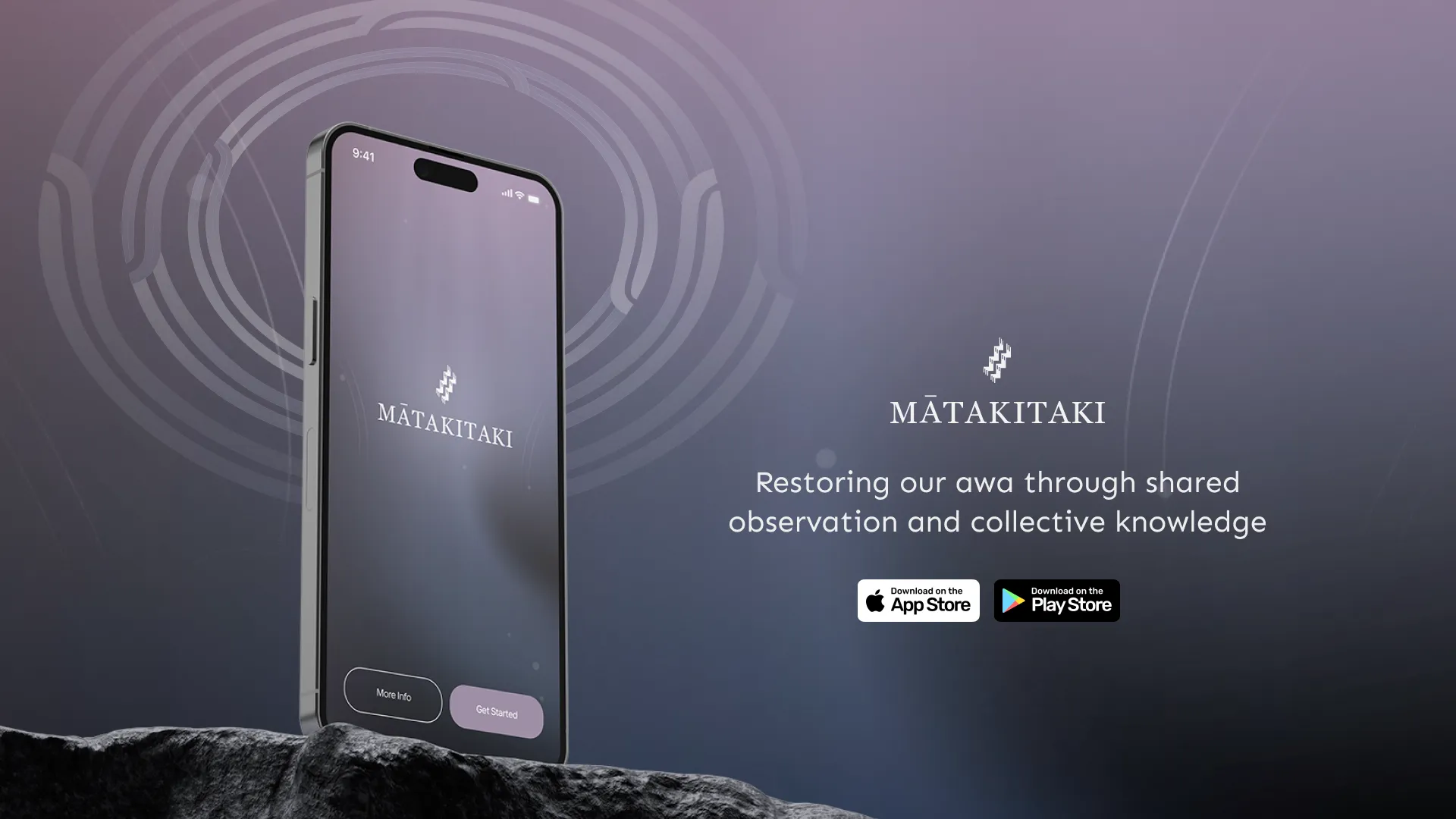
Mātakitaki is a conceptual mobile app created to restore Aotearoa's rivers using indigenous knowledge systems.
Mātakitaki supports recording and sharing mātauranga Māori seasonal knowledge
and environmental relationships through modern
tools, enabling community-led environmental restoration through community awareness and relational ecological
knowledge.
Grounded in te maramataka, the app focuses on relationships in te taiao and their impact on the wider awa,
creating a shared, private space for local iwi and hapu or the local public to observe, interpret, and pass on
local environmental knowledge. It
supports the continuation of Indigenous knowledge systems while responding to the modern pressures facing our
awa
today.
Overview
The app encourages users to reconnect with te taiao and collectively help restore Aotearoa's awa by
recording seasonal patterns and mauri indicators of the awa. The system is informed by maramataka, a Māori
timekeeping and knowledge system used for centuries be local iwi, now supported through technology. Mātakitaki acknowledges that true observation is, at its core, a human experience. Something that cannot be replicated by technology, AI, or machine learning. Mātakitaki’s kaupapa is to support, not replace, human observation, using technology as a modern way to store, connect, and share knowledge in response to increasing pressures on our awa.
Problem Statement
Aotearoa's rivers are under severe strain. Many environmental applications communicate river health through
numerical metrics, dashboards, and simplified indicators. While effective for scientific analysis, these
approaches often overlook relational Indigenous knowledge systems, where ecological understanding is built
through observation, memory, and hononga (relationships) between life in the ecosystem and seasonal and
lunar patterns. These knowledge systems have sustained the awa and the wellbeing of communities for
centuries, but much of this knowledge is now at risk of being lost.
Design Question
How might digital tools support a return to Indigenous relational ways of observing and restoring the
environment, without
replacing lived experience or allowing technology to do the observing for us?
Onboard Flow
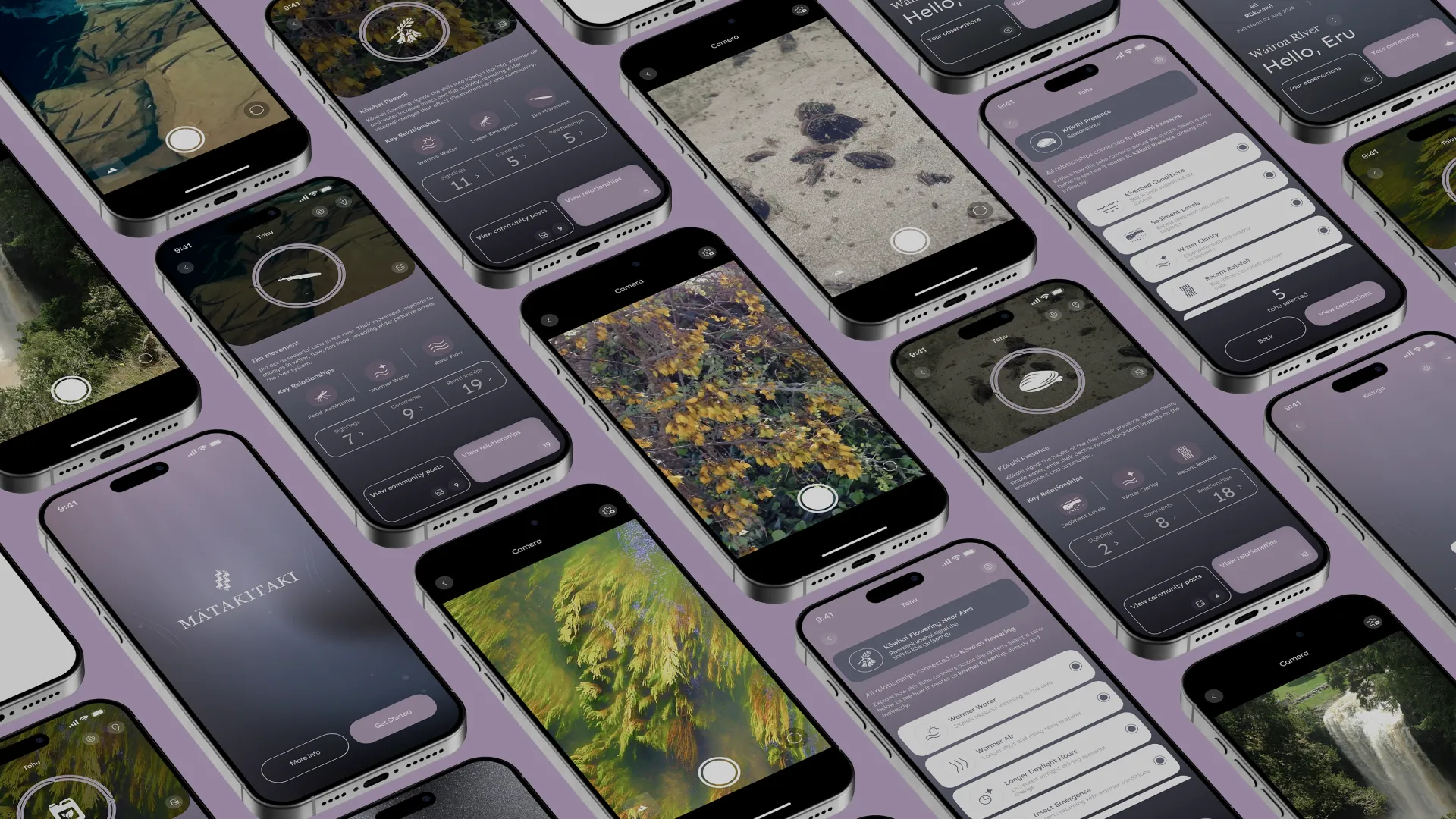
The onboarding experience establishes a relationship with the awa from the first interaction. Fluid transitions and water-inspired UI create a sense of continuity, allowing the interface to move and respond like the environment it represents. Rather than feeling like a sequence of screens, the onboarding becomes an introduction to the awa and the relationships that shape the experience.
User Interface
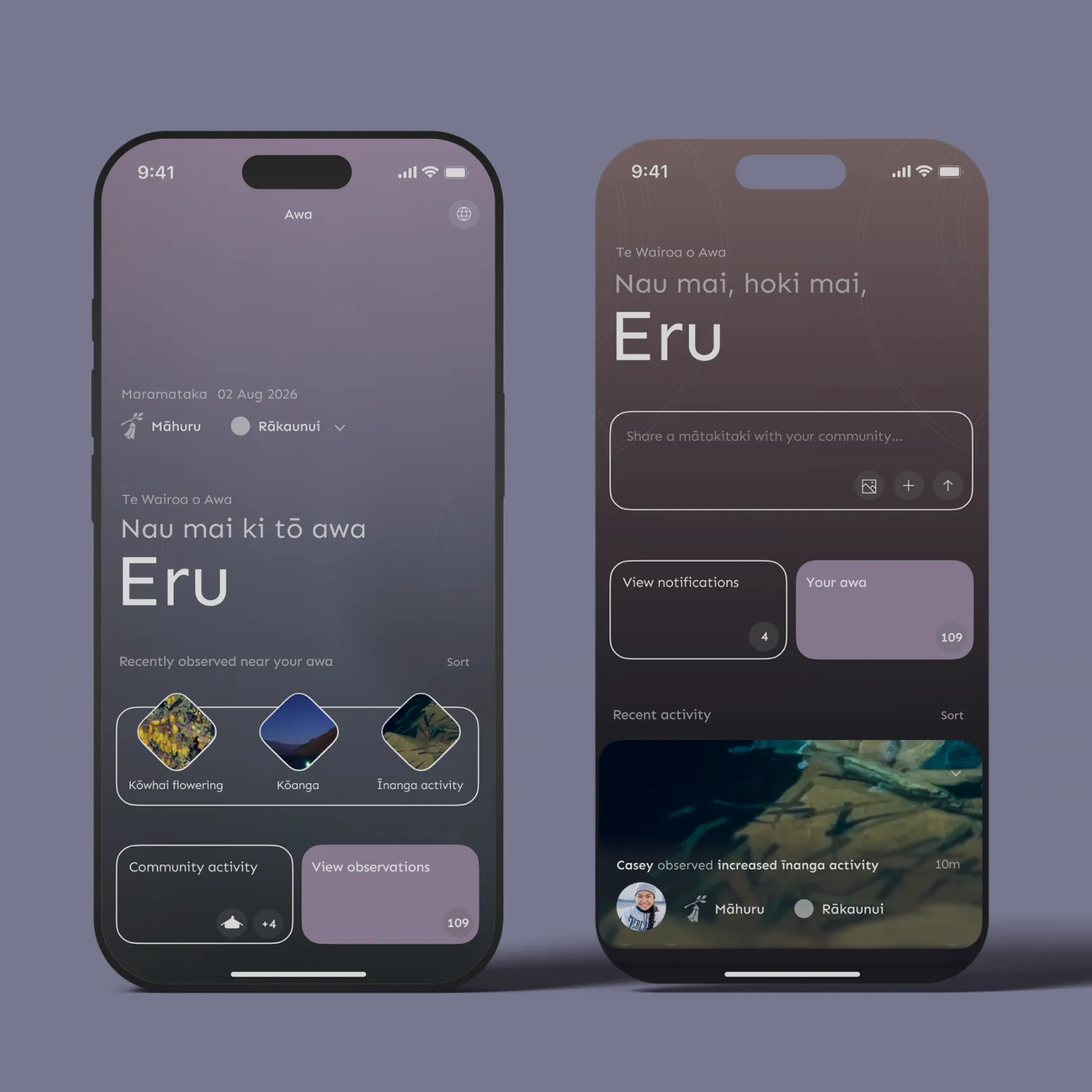
The interface is designed to feel as if the awa and the community hub are within walking distance of one
another. An intentional reminder of the connection between awa and local people. Separating Awa and Hapori reduced cognitive load and helped users stay oriented within the system.
Awa
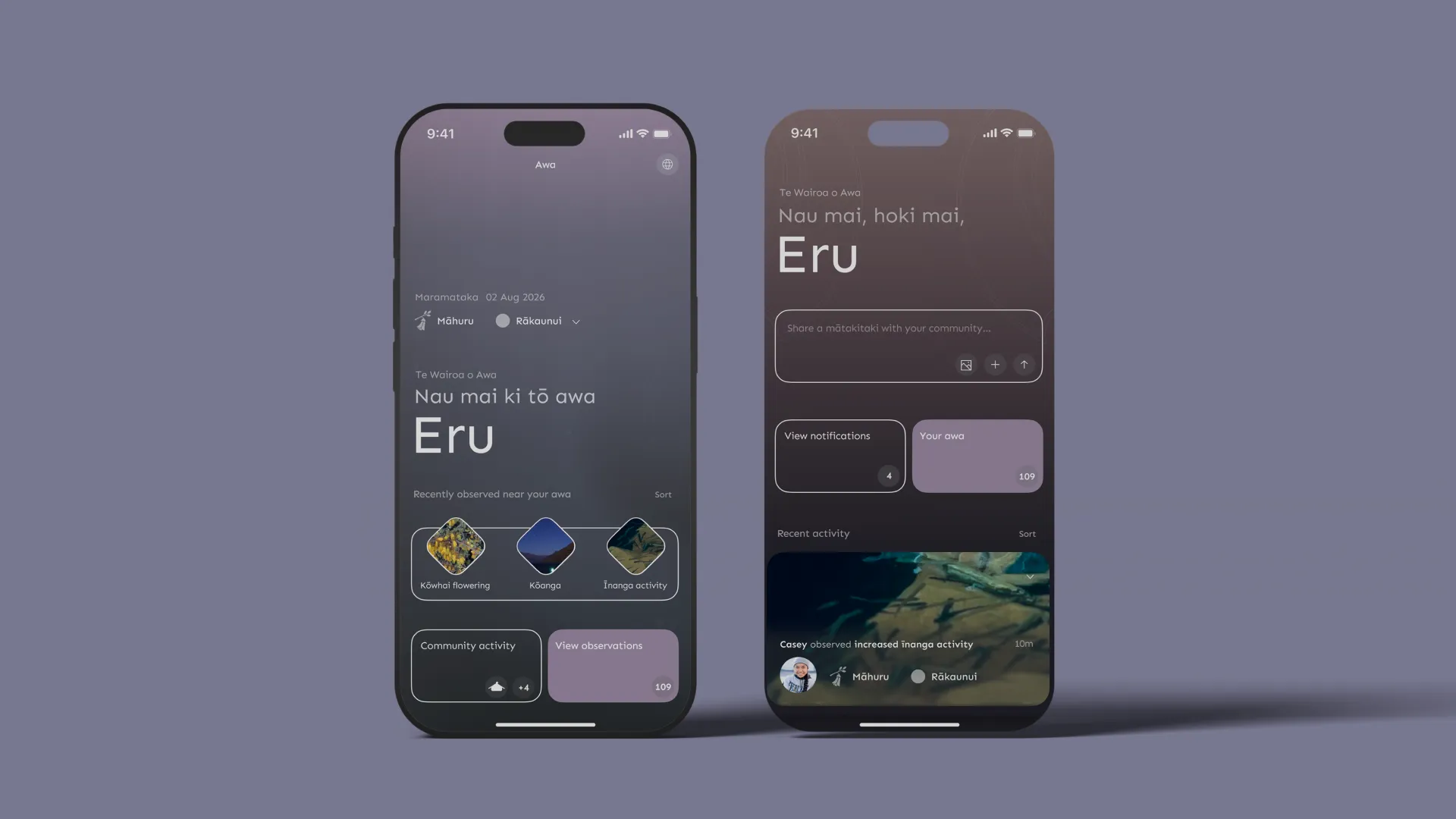
The awa screen provides a clear, immediate view of river wellbeing by surfacing three recently observed or mentioned tohu, representing key hononga within the system. At the top, the maramataka timekeeping system displays the current marama season on the left and moon phase on the right, grounding observations in seasonal and lunar context. From this screen, users can explore all observations or return to the community. The awa screen displays the three most recent tohu
to give users an immediate sense of river state without overwhelming them.
Hapori
The community screen supports social interaction, allowing users to contribute kōrero and link observations to
expand the overall hononga network within the database.
This reflects how environmental knowledge is traditionally shared through kōrero, rather than static
datasets.
Observe and capture
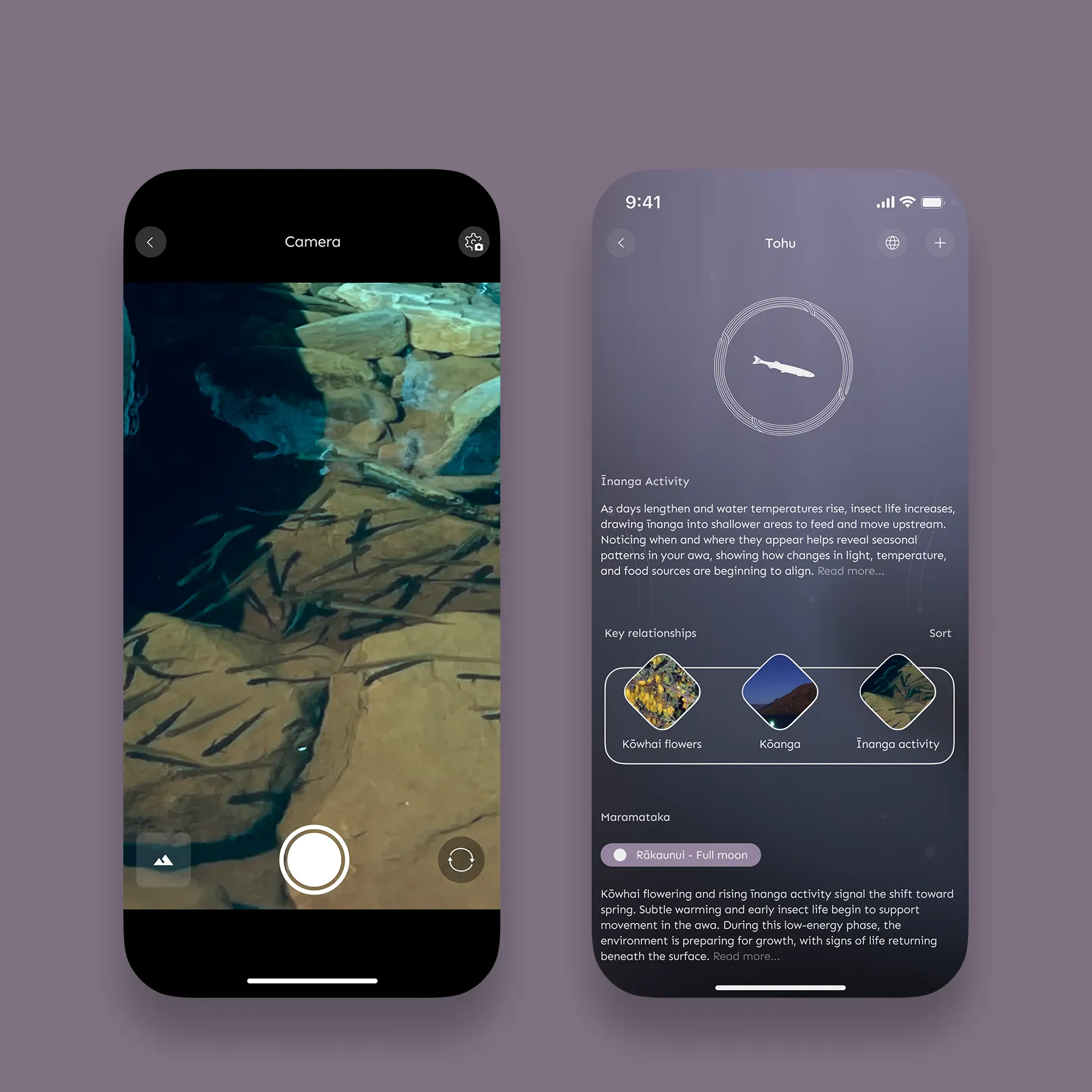
User observations of tohu (environmental indicators), recorded through photos and video, act as the primary input for the system. These inputs shape a relational interface where tohu connect through hononga (relationships), revealing patterns of balance and wellbeing within the awa.
Observe te taiao (the living world) around your local awa and document seasonal changes through photos or
video to create records of tohu. As observations grow, your community builds a shared, locally owned understanding of the awa,
grounded in lived experience rather than extracted data. This establishes understanding and preparation to
help restore the awa.
This approach prioritises active observation over automated data collection,
ensuring knowledge remains grounded in lived experience rather than passive and automated.
Once recorded, each tohu is represented through a unique icon and circular Māori surface patterns. This visual language reflects the relational nature and balance of the awa, while framing each record as both a memory and a symbolic indicator of seasonal change
Instead of test results, statistics and numerals, tohu screens instead show their most recent or most talked about relationships, again reinforcing the relational nature of restoration.
Hononga node network
Observations are stored within a visual hononga diagram, revealing how different tohu interconnect. The
system is moderated and organised by tohunga, with optional AI support, to maintain a trusted, secure
knowledge base grounded in local observation and maramataka (seasonal and lunar cycles).
This replaces traditional metric-based dashboards with a relational system, allowing users to understand
ecological cause and effect rather than isolated data points.
Contribute to your community's posts
Each post provides simple actions to connect with existing and to expand the node network, linking
relationships through interaction to build a visual network of local hononga from the community over time.
The system is designed so knowledge emerges through interaction, rather than being predefined, reinforcing a
community-led understanding of the awa.
The system is designed to remain minimal and easy to navigate, using clear labels for tohu hononga and maramataka. Relationships are structured through simple nodes and tags, allowing connections to be made easily.
Brand Identity & Story
Inspired by Waitī, the matariki star
The visual identity draws inspiration from Waitī, the freshwater star of the Matariki
cluster, and twin of the saltwater star Waitā. I utilised an indigo, purple, blue and pink palette that embodided the mystical property of wai and notes of the feminine nature of Waitī,
compared to her male twin.
Deep gradients and pūhoro-inspired surface line-work reflect the fluid movement of water and light. The ripple-like whakarare pattern represents how relationships within the awa extend outward, creating a ripple effect across the ecosystem.
Design Approach
A relational approach to ecological knowledge
Instead of scoring river health, the app displays tohu (observed seasonal indicators) within the living world and allows users to connect them through hononga (relationships), building a
shared knowledge system based on observation and memory. Health is not calculated by algorithms.
It emerges through relationships in the awa and is solved through community/council interpretation and
discussion.
Key UI design decisions
• Replaced metric dashboards with a relational tohu + hononga system, allowing users to understand ecological cause and effect rather than isolated data points
• Prioritised community-led knowledge over automated systems to ensure insights remain grounded in lived experience rather than passive data collection
• Introduced optional back-end AI to organise community data, improving clarity without compromising data sovereignty or increasing user effort
• Refined the tohu network into nodes and tags, creating a minimal structure that keeps relationships readable while maintaining ecological accuracy
• Introduced dual navigation (list + bubble network) to balance accessibility with deeper relational exploration, supporting both quick scanning and emotional engagement
Constraints and trade-offs
• A key trade-off was balancing ecological complexity with usability. While environmental systems are deeply interconnected, simplifying the interface was necessary to keep relationships readable and accessible. The key was to create access points that lead to deeper knowledge when needed and when users desired during testing.
• Translating concepts such as tohu and hononga into a digital interface required balancing cultural accuracy with usability, as these ideas do not directly map to conventional UI structures.
• Introducing AI offered efficiency in organising community knowledge, but raised concerns around environmental cost and data sovereignty, leading to an optional and localised approach.
• Balancing emotional, culturally expressive visuals with functional clarity required restraint, ensuring the interface remained usable while still conveying the unique nature of the knowledge system.
Reflection
This project strengthened my ability to design systems that guide interpretation rather than simply display information, especially when working with complex, culturally grounded knowledge.
One of the most challenging aspects was designing around te reo Māori concepts such as tohu
and hononga. These ideas do not translate directly into English, which made structuring navigation and UX
language more complex. For example, hononga holds meanings of both connection and relationship, while also
existing as its own concept. Designing with this in mind required more care, but ultimately led to a more
meaningful system.
Given more time, I would continue refining how hononga are visualised, exploring more Māori patterns, motiffs or icons, and trying spatial or 3D scans of the river for a high-tech dashboard. A key focus would be improving how relationships
between nodes are expressed, especially in the community or when community members interact and connect
nodes, ensuring the system remains minimal while still feeling emotionally engaging and cognitively clear.
I would also continue user testing to refine how people interpret and navigate these relationships, while
strengthening consistency across the UI through scale, spacing, and overall system cohesion. I would further
develop culturally grounded UI elements, and collaborate with fluent te reo speakers to strengthen the
language and interaction design. I would explore a maunga version of the app for mountain or land recovery and how that could be branded uniquely.